What Does a Good Mortgage Broker Website Actually Need in 2026?
A practical guide to the website features, content, CMS choices, calculators, compliance, SEO and AEO that can turn a mortgage broker website into a useful long-term marketing asset.
There’s a fairly big difference between having a mortgage broker website and having a website that actively helps grow a mortgage broking business.
A basic site can be perfectly respectable. Home page. About page. Services. Contact form. Maybe a few testimonials. It tells people you exist.
A more developed mortgage broker website can do considerably more. It can answer the questions prospective borrowers are already searching for, help people understand complicated lending terminology, demonstrate the experience of the brokers behind the business, generate enquiries, support local SEO and give Google and AI search engines considerably more information about who you are and what you know.
I build websites, and mortgage broker websites are an interesting category because there is so much useful content you can add without turning the site into a mess. Some things are essential. Some are nice to have. And some can make a surprisingly large difference once you start thinking about SEO, answer engines and long-term visibility.
This isn’t a “Top 10 website builders” article. It’s based on the features, content structure and publishing systems I’ve found most useful when planning and building mortgage broker websites.
1. Start with the basics and get them right
Before adding clever features, the website needs to work properly. That means clear navigation, excellent mobile layout, fast loading pages, HTTPS, accessible text and controls, clear contact information, prominent enquiry or booking options, sensible page titles and heading structure, good internal linking and properly optimised images.
I would also make the main action obvious. For most mortgage brokers that will be something along the lines of Book a consultation, Speak to a broker or Get started. You don’t need five different calls to action competing for attention on every screen.
2. Give every major lending service its own useful page
One generic “Home Loans” page usually leaves a lot of opportunity on the table. Depending on the business, I might create individual pages for first home buyers, refinancing, investment loans, construction loans, commercial lending, self-employed borrowers, debt consolidation, asset finance, SMSF lending and bridging finance.
Somebody looking for help refinancing has different questions from somebody trying to finance their first property. A strong refinancing page also gives a search engine substantially more context than one paragraph about refinancing sitting halfway down a general services page. Each page gives you somewhere relevant to link from future articles.
3. Mortgage calculators can turn a static website into a useful tool
Mortgage calculators are one of the first additions I would seriously consider.
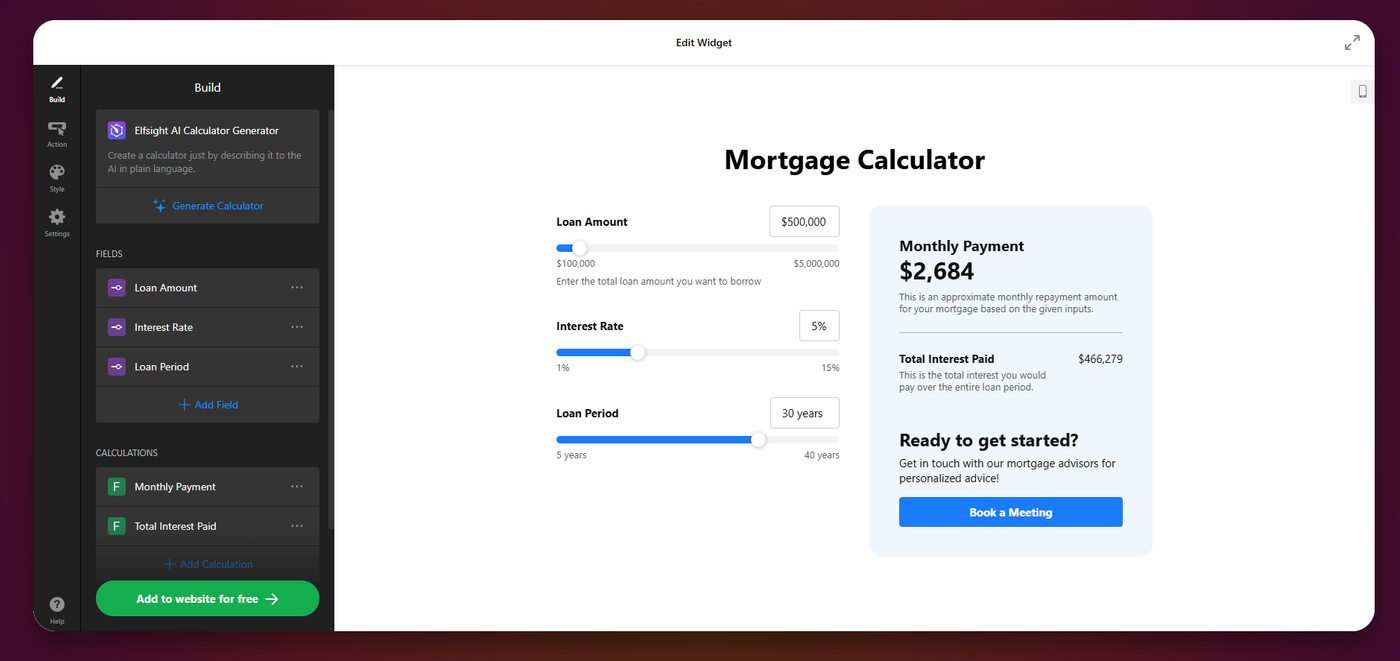
There are third-party calculator providers that allow mortgage brokers to embed calculators into their websites, so you generally don’t need to develop the mathematics and interface from scratch.
- Mortgage repayment calculator
- Borrowing power calculator
- Stamp duty calculator
- Extra repayment calculator
- Refinance calculator
- Loan comparison calculator
One option worth looking at is Elfsight’s embeddable calculator. It has a free plan, which makes it an easy way to test an interactive calculator before committing to something more sophisticated. I’d still judge any calculator on mobile behaviour, load speed, accessibility, styling flexibility and whether it actually encourages a visitor to speak with the broker.
There is probably an entire article in this alone: Which Mortgage Calculator Should You Use on an Australian Mortgage Broker Website? I’ll come back to that.
4. Build a proper mortgage information centre
This is where a good mortgage broker site can start becoming genuinely valuable. People encounter an enormous amount of unfamiliar terminology when buying property or comparing loans: LVR, LMI, offset, redraw, comparison rates, fixed rates, variable rates, guarantors, pre-approval, refinancing and equity.
Instead of assuming visitors already understand these terms, build a useful resource area around them. You could create guides explaining what LVR is, how lenders mortgage insurance works, how an offset account works, what loan pre-approval means, fixed versus variable home loans, what happens when you refinance and how much deposit first home buyers may need.
These don’t need to be massive articles every time. A well-structured content management system makes it practical to build dozens of useful resources over time. Moneysmart’s home loan resources are a useful example of how broad the information needs of an actual borrower can be.
5. Put genuinely useful FAQs on the pages where people need them
I like FAQs, but I don’t particularly like enormous generic FAQ pages filled with questions nobody asked. Put the questions where they make sense.
A refinancing page might answer questions such as how much refinancing costs, when it may be worth considering, whether you can refinance with the same lender and what happens if you’re self-employed. A first-home-buyer page will have a completely different set. A construction loan page should answer construction loan questions.
This helps the person reading the page and creates a richer document for search engines to understand. It can also feed structured data where appropriate, although I wouldn’t build FAQs purely because somebody once heard Google likes FAQ schema. The content needs to earn its place on the page.
6. Broker profiles deserve more than a photograph and two sentences
If I’m choosing somebody to help me with a very large financial decision, I want to know who that person is. A good broker profile can include professional background, qualifications, areas of lending experience, years in the industry, locations served, types of clients they commonly help, professional memberships, licences or representative information where appropriate, genuine personal information, photographs and contact details.
You can also link articles to their authors. That starts connecting the expertise demonstrated in your content with an actual person. Thin staff pages waste this opportunity. If you’ve spent fifteen years helping people finance property, say something meaningful about those fifteen years.
7. Compliance needs to be part of the copywriting process
Mortgage brokers operate in a regulated industry, so website copy can’t be written with the same freedom as copy for a cafe or landscaping company. This needs to be considered during the writing process, not bolted on five minutes before launch.
ASIC’s Regulatory Guide 234 covers advertising of financial products, financial services, credit products and credit services, including misleading or deceptive advertising. ASIC updated the guide in June 2026. Mortgage brokers also operate under best-interest obligations when providing credit assistance.
For a website, that means being careful about sweeping claims. Words such as “best”, “independent”, “unbiased”, “guaranteed” or claims implying access to the entire lending market deserve particular scrutiny. Good marketing copy can still be persuasive. It just needs to be supportable.
8. Publish useful articles regularly
You don’t need to publish five articles a week. I’d rather see a broker publish one genuinely useful piece of content regularly than fill the website with thin AI-written posts nobody would willingly read.
Topics can come directly from client conversations. If borrowers keep asking whether they should fix their mortgage rate, that’s an article. If people don’t understand offset accounts, that’s an article. If investors are confused about usable equity, that’s an article. If a government scheme changes and it affects first home buyers, update your resources.
You already have access to the subject matter. The questions walk through the door every week. The website simply gives those answers a permanent home.
9. Your CMS matters more once you start doing this properly
Once a website contains twenty, fifty or a hundred useful articles, staff profiles, FAQs and lending resources, content management starts mattering. There are several good approaches.
WordPress for mortgage brokers
WordPress remains an excellent choice for content-heavy websites. Its blogging capability is mature, there is an enormous ecosystem around it, and you have plenty of freedom over how the site is built.
For mortgage broker WordPress websites, I personally like Divi and Avada. There are plenty of other WordPress builders and themes, including Elementor. I’m not particularly interested in turning this into a religious argument about page builders. I’ve worked with enough of them to have preferences. Divi and Avada are the two I’d currently be most inclined to use when I want a highly customisable WordPress build with a strong visual editing environment.
Webflow for mortgage brokers
Webflow gets particularly interesting when the content goes beyond a conventional blog. Its CMS is based around structured Collections. A Collection might contain blog posts, but it could just as easily contain broker profiles, loan guides, locations, case studies or another repeating content type.
You design the template once and then create structured entries from the CMS. Imagine a mortgage brokerage with 15 locations. Instead of manually maintaining 15 unrelated pages, you could have a Locations Collection containing structured information for every branch. Update the data and the template takes care of how it is presented. The same idea works for brokers, lending products, guides and case studies.
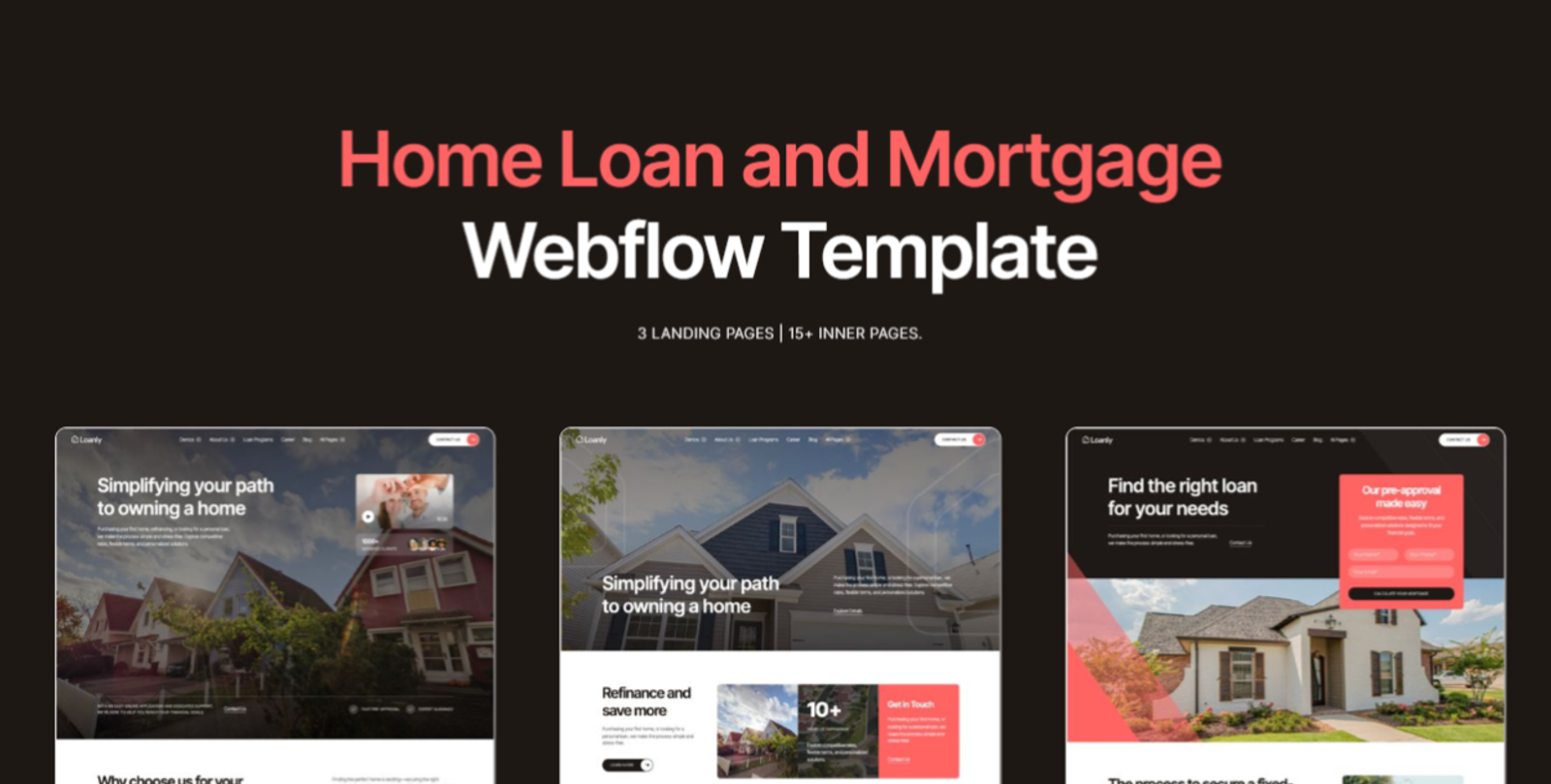
If you want to see what a purpose-built starting point can look like, the Loanly home loan and mortgage Webflow template includes mortgage-focused layouts as well as CMS collections for loan programs, team members and blog content. I wouldn’t use any template unchanged, but a well-designed template can be an efficient starting point when it suits the brief.
Squarespace for mortgage brokers
Squarespace shouldn’t be dismissed either. For a smaller mortgage broking business that wants a professional site and a straightforward publishing workflow, it can be a very sensible choice. Its blogging tools are strong and it’s a good fit for a solo broker who wants service pages and an easy way to publish useful articles.
A custom next-generation website with a headless CMS
There is another approach that is becoming increasingly interesting: separating the website from the content management system.
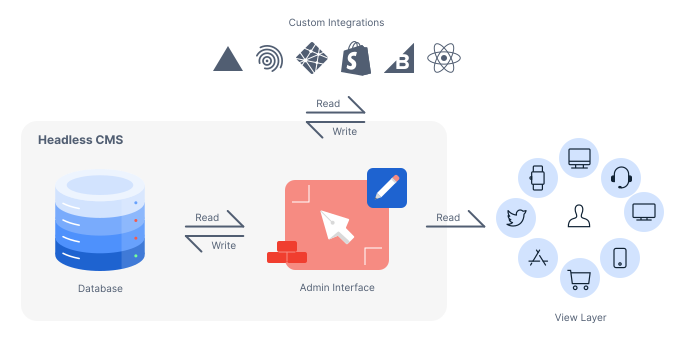
This is usually called a headless CMS architecture. The website handles presentation. The CMS handles content.
For example, articles might live in a platform such as Sanity while the public website is a separately developed frontend. Your content isn’t buried inside the website builder itself. If the frontend is redesigned or replaced later, the content database can potentially remain where it is and be connected to the new frontend.
I recently moved my own website blog to this type of setup, partly because I wanted the freedom to publish content without having to alter the website application every time I wrote an article. It’s a more technical architecture and certainly isn’t necessary for every mortgage broker. For the right project, though, it’s powerful.
10. Add structured data properly
Structured data — usually JSON-LD using Schema.org vocabulary — gives search engines explicit information about what they’re looking at. For a mortgage broker website, this might include appropriate structured information about the business, people, articles, breadcrumbs, images, services and FAQs where applicable.
I wouldn’t treat schema as magic SEO dust. It is another way of making the site’s information easier for machines to interpret. The implementation should also match what is genuinely visible on the page.
11. Think about SEO and answer engines together
Search is changing. Traditional SEO still matters enormously: crawlable pages, useful content, links, good titles, strong information architecture, authority, local relevance and technically sound websites remain fundamental. But there is now another audience consuming all that information: AI systems.
People increasingly ask ChatGPT, Gemini and other answer engines questions they previously typed directly into Google. That makes clear, well-structured information increasingly valuable. If your website clearly explains who you are, where you operate, what services you provide, who provides them, what experience those people have and the questions borrowers commonly ask, machines have considerably more context to work with.
I’d concentrate on publishing useful, well-structured information and making the business itself extremely easy to understand rather than chasing a mysterious new AEO trick.
12. Internal linking should be planned rather than accidental
Once you start building this content, connect it. Your article explaining LVR should link naturally to relevant first-home-buyer and refinancing information. Your refinancing page can link to the refinance calculator. Your broker profile can link to articles written by that broker. A construction lending guide can link to your construction loan service.
This helps visitors continue exploring the site and gives search engines a clearer understanding of how the information relates. It’s also one of the reasons a large information centre becomes more valuable as it grows. You’re building a web of useful information rather than a folder full of disconnected posts.
13. Local information can be extremely valuable
Mortgage broking is often geographically relevant even when consultations happen online. If a brokerage genuinely serves particular locations, the site should make that clear. That may include office locations, areas serviced, Google Business Profile integration, locally relevant reviews, broker profiles connected with locations and local property or lending information where useful.
Avoid creating hundreds of near-identical suburb pages with the suburb name swapped out. If you’re going to create local content, give the page a reason to exist.
What I would prioritise
If I inherited an average mortgage broker website tomorrow, I wouldn’t try to add everything at once. I’d get the commercial pages right first. Then I’d start building the supporting content around the questions actual borrowers have.
Foundation: strong service pages, broker profiles, mobile UX, conversion paths, compliance and technical SEO.
Useful tools: calculators, booking and helpful resources.
Authority: regular articles, detailed FAQs, educational guides and internally linked resources.
Technical depth: structured data, sophisticated CMS architecture, strong entity information and deliberate optimisation for both search engines and AI discovery.
You can build a perfectly good mortgage broker website without every feature in this article. But if you’re serious about using the website as a marketing asset over the next five or ten years, give yourself somewhere to grow.
The strongest mortgage broker websites I’ve worked on or planned aren’t really brochures anymore. They are increasingly becoming useful publishing platforms attached to a mortgage broking business. And that opens up far more interesting possibilities than another home page with a picture of a smiling couple holding a set of house keys.
Recommended resources
The platforms and tools below are all capable of contributing to excellent mortgage broker websites when they’re matched to the right project. I use several of them regularly, and each has strengths depending on your goals, budget and publishing requirements.
- Webflow — visual development platform with a particularly strong CMS for structured content and dynamic pages.
- Sanity CMS — headless CMS that separates content from the website frontend.
- Squarespace — polished platform with a straightforward publishing workflow for smaller businesses.
- Divi for WordPress — my preferred WordPress visual builder when flexibility and rapid customisation are important.
- Avada — mature WordPress framework suited to highly customisable business websites.
- Elfsight Calculator Widget — embeddable calculator tool with a free plan for testing interactive calculators on a website.
- Loanly Mortgage Webflow Template — a mortgage-focused Webflow template with multiple layouts and CMS content types.
Prefer a printable checklist? Download the 14-page Mortgage Broker Website Field Guide with 50+ website essentials, a homepage blueprint, calculators, SEO, conversion and a 25-point self-audit.
Download the Free Mortgage Broker Field GuideCommon questions
What should a mortgage broker website include?
At minimum, a mortgage broker website should have clear service pages, broker information, strong mobile usability, clear enquiry or booking options, compliant copy, useful FAQs, fast performance and sound technical SEO. Calculators, educational resources, structured data and regular publishing can add considerably more value over time.
Which website platform is best for mortgage brokers?
There is no single platform that suits every brokerage. WordPress is strong for flexible content-heavy sites, Webflow is excellent for structured CMS content and dynamic pages, Squarespace suits many smaller businesses, and a custom frontend with a headless CMS such as Sanity can suit more advanced projects.
Should mortgage broker websites have calculators?
Calculators can be genuinely useful when they work well on mobile, load quickly and support the visitor’s next step. Repayment, borrowing power, refinance and loan comparison calculators are common options. Third-party tools can often be embedded without building a calculator from scratch.
Do mortgage brokers need to publish blog posts?
Regular useful publishing can help a brokerage answer borrower questions, build a deeper body of lending information and create more opportunities for search visibility and internal linking. Quality and usefulness matter more than publishing at a high frequency.
Why does mortgage broker website compliance matter?
Mortgage brokers operate in a regulated credit environment. Website claims and advertising need to be accurate and supportable, with particular care around claims such as best, independent, unbiased or guaranteed. ASIC guidance should be considered during the copywriting and review process.
Want a second opinion on your own site?
Start your project